Saturday, 13 July 2019

MERCHANT OF VENICE ACT 1 SCENE 2
 MERCHANT OF VENICE ACT 1 SCENE 2
Image result for merchant of venice act 1 scene 2
Extract I
1.    What has Portia just said in response to which Nerissa speaks these words?
Portia has just  said that she can neither choose the one she likes nor refuse the one she dislikes because the choice of her husband depends on the lottery of caskets devised according to her late father’s will.

2.    Describe the lottery referred to in the extract.
The lottery refers to the choice of the right casket containing Portia’s portrait from a among the three caskets of gold, silver and lead. The suitor who will make the right choice as per the will of Portia’s father will win her in marriage.

3.    Give the reaction of Portia as well as of Nerissa to the lottery.
Initially, Portia appears to be anxious over the prospect of choosing her husband through a lottery devised according  to her father’s will. She feels sad as she can neither choose the one she likes nor refuse the one she dislikes as her husband. But later on she accepts her father’s will. Nerissa’s reaction to the lottery was positive. She calls Portia’s father pious and asserts that good men do have inspirations at the time of death. She consoles Portia by saying that she will be chosen correctly by a person whom she truly loves.

4.    Give the meaning of “never be chosen by any rightly, but one who you shall rightly love.”
These lines mean that Portia will be chosen correctly by a person whom she truly loves.

5.    Portia is melancholic in the beginning of the scene as it was the case with Antonio in the previous scene. What is the difference between Antonio’s melancholy and that Portia?
Portia’s melancholy is the result of her anxiety over the prospect of her future husband while the cause of Antonio’s melancholy is unknown.

6.    How does this scene show a mood  of melancholy, anxiety and suspense?
The scene show a mood  of melancholy, anxiety and suspense. The mood of melancholy and anxiety is due to the prospect of Portia’s future husband to be decided by the lottery designed according to her deceased father’s will. This also creates an atmosphere of suspense. The conversation between Nerissa and Portia, Portia’s comments on the  suitors  and Nerissa’s reference to Bassanio as ‘the best deserving  a fair lady’ increase the elements of anxiety and suspense in the scene.
Extract 2
Image result for merchant of venice act 1 scene 2
Portia:
He doth nothing………………God defend me from these two!
1.    Where are Portia and Nerissa? What  are they generally discussing about? In what mood is Portia in the scene?
Portia and Nerissa are in a room in Portia’s house at Belmont. They are discussing the lottery of caskets and about the suitors who have already come to try their luck. In this scene, Portia is in a mood of melancholy and anxiety.

2.    Who is County Palatine? Why has he come to Belmont?
County Palatine was the Count from Palatinate, the region on the west bank of the Rhine in Germany. He was a powerful lord who came to Belmont to win Portia’s hand.

3.    Who is the first prince described by Portia? What does she say about him?
The first prince described by Portia is the Neapolitan Prince from Naples, Italy. Portia describes him as a dashing  youngster and as wild as a young horse. He does nothing but talks of his horse. He further considers his ability to shoe a horse himself as a great accomplishment.

4.    Who is the weeping philosopher? In which context is he referred to in the extract?
The weeping philosopher refers to Heraclitus of Esphesus. He was a Greek philosopher who lamented the stupidity and folly of mankind and wept at everything in the world. Portia refers to him to describe County Palatine. She feels that since County Palatine is usually gloomy in his young age, he will become a sad philosopher like Heraclitus when he grows old.

5.    Give the meaning  of:
A)  An you will not have me, choose
If you do not want me , choose anyone you wish
B)   A death’s-head with a bone in his mouth
 A skull with a bone in its mouth. The emblem of a skull with two bones crossed underneath was usually known as ‘death’s head.’

6.    Give a character-sketch of the County Palatine.
County Palatine is described as gloomy and self-conceited person. He is always frowning  as if to say that if Portia will not marry him, she may choose someone else. He is morose and sullen that even jovial stories don’t make him laugh. He has an abrupt manner of speech and may become a sad philosopher like Heraclitus when he grows old.

Extract III
Portia:
God made him, and therefore let him pass for a man…….I shall never requite  him.
1.    What has Portia said earlier about Neapolitan prince and his horse? Which characteristic is common between Monseieur  Le Bon and the Count Palatine?
Earlier Portia described the Neapolitan Prince as wild as a young horse and so attached to his horse that  he always spoke about the horse only. The Count Palatine and Le Bon share the common characteristic of frowning.

2.    Give the meaning of:
A)  He is every man in no man: He has every man’s characteristic  but no personality of his own
B)   He falls straight a -capering: He starts to jump about. Monsieur Le Bon is so fickle-minded that if he hears a thrush sing, he starts to jump about.

3.    How does the French lord react to the singing of a thrush?
When he hears the singing of a thrush, the French Lord starts jumping immediately.

4.    What would happen:
a)    If Portia were to marry the Count?
It would be as if she were married to twenty husbands as he is never one man but twenty men by turns.
b)    If he were to despise Portia?
If he were to despise Portia, Portia would not be in  least angry and would forgive him.
c)    If he were to love Portia passionately?
Portia could never return his love since she could never possibly love twenty husbands.

5.    Give any three negative qualities of the French Lord, as described by Portia.
Portia says that the French Lord is more attached to his horse than the Neapolitan Prince and excels Count Palatine in frowning. If he hears a thrush singing, he starts jumping immediately. Further, if he does not have anybody to fence with, he will take his own shadow as adversary.

Extract IV
Portia

You know I say nothing……………………and his behaviour  everywhere.
1.    How is the young baron’s external appearance described in the passage? What light does it throw on the national pattern of clothes of Englishmen?
The baron’s external appearance is described as odd and strange. He is oddly dressed and very odd in behaviour too. He wears an Italian jacket and breeches in the French fashion. He seems to have got his hat from Germany and his manners from everywhere. Englishmen of Shakespeare’s days had fondness for the manners and clothes of foreigners.

2.    What shows that the English Lord has poor knowledge of the European languages? Why does Portia find it difficult to interact with him?
Portia’s sentiment that the Englishman did not know Latin, French or Italian shows that he had very poor knowledge of European Languages. Portia found it difficult to converse with him as he did not know Latin, French or Italian and Portia’s knowledge of English was very poor.

3.    Give the meaning of:
a)    He is a proper man’s picture
He is handsome and fine-looking
b)    How oddly he suited: He is dressed very strangely

4.    What is referred to as a ‘dumb show’? why is the baron said to be a dumb show?
The word dumb-show refers to a play in which all characters act without speaking , that is by gestures. A pantomime is a dumb show. Here it means that the Englishman is unable to speak foreign languages and had to converse by means of signs as in a dumb show.

5.    Give a brief description of the Scottish Lord
The Scottish Lord is not impressive. Portia speaks about his cowardice in a sarcastic way by calling him kind-hearted as he did not return the Englishman’s blow immediately.

6.    What type of contemporary relationship among England, Scotland and France is reflected in the description of the Scottish Lord?
The description of the Scottish Lord is a reference to the frequent alliances between the Scots and the French again England when Scotland was at war with England.

Extract V
Portia
Very vilely in the morning, when he is sober………………..ere I will be married to a sponge.

1.    How does  the young German behave when he is sober and when he is drunk? If the worse happens to Portia which would compel her to marry him, what would she do?
When sober, the young German is less than a man in behaviour  and when drunk he is no better than a beast. If the worse happens to Portia, she will manage to do  without him.
2.    Give the meaning of:
a)    When he is worst, he is little better than a beast
When is drunk, he is no better than a beast
b)    Set a deep glass of Rhenish wine on the contrary casket
Place a  tall goblet of Rhenish wine on the wrong casket

3.    What plan does Portia  make to prevent the young German from choosing the right casket?
To prevent the young German from choosing the right casket, Portia instructed Nerissa to place a tall goblet of Rhenish wine on the wrong casket. Portia was sure that the German suitor  will not be able to resist the temptation of his national drink even if the picture of the devil himself was within.

4.    Why is the young German referred to as a ‘sponge’?
A sponge constantly absorbs water. Similarly, a drunkard, who constantly take liquor is called a sponge. Since the young German is a drunkard, Portia calls him a sponge.

5.    After  Portia’s speech, what does  Nerissa say to console her about the suitors?
Nerissa tells Portia to set aside her fears concerning the suitors. She says that they have informed her of their  decision to go back home and not to press their courtship further unless Portia’s  father’s decree concerning the caskets can be set aside and they may woo her in an ordinary way.

Extract VI
Portia
If I live to be as old as Sibylla…………………..a fair departure.
1.    What was Portia’s father’s will as far as Portia’s marriage is concerned?
Portia’s father’s will was that her marriage will be decided by the lottery of the three caskets. The suitor, who chooses the right casket containing Portia’s picture will be her husband.

2.    Who is Sibylla and who is Diana? Why are they referred to in the extract?
In Ovid’s metamorphoses, Sibyl was prophetess. She was granted a wish by god Appllo that she would live for as many years as the grains of sand she held in her hand. She was the ageless old woman.
Diana was the goddess of moon and hunting. She is known as the virgin goddess. They are referred to here to explain Portia’s resolve to remain a virgin like Diana even if  she lives to be as old as Sibyl of Cumae unless she is won in marriage by some suitor in the lottery of casket.
3.    What does Nerissa say to introduce Bassanio? What were the feelings of Portia for Bassanio in this scene?
To introduce Bassanio, Nerissa recalls the visit of a young Venetian along with the Marquis o f Montferrat, when Portia’s father was alive. He was a scholar and a soldier. In this scene, Portia’s feelings for Bassanio are quite positive. She recalls his name and tells Nerissa that he fully deserves her praise. Her simple reply shows that she is already in love with Bassanio.

4.    In what scene can we say that the opening of the first two scenes of Act I give the plots of the play?
The opening of the first two scenes of Act I gives the plot of the paly. The two main plots of the play are the bond-story and the casket -story. The bond-story is initiated in Scene I while the casket-story is initiated in Scene 2 of Act I.

5.    Name the six suitors given in this scene. Give two characteristics of each suitor described by Portia.
i)                The Neapolitan Prince from Naples, Italy, was a dashing youngster, as wild as a horse. He always talked about his horse.

ii)             The County Palatine was always frowning  and unusually gloomy.

iii)           Le Bon is from France, who had the characteristic of every man and had no personality of his own.

iv)            Falconbridge from England, though handsome was strangely and unmannerly dressed and did not know Latin, French  or Italian.

v)              The Scottish Lord, was a coward and did not repay the Englishman who gave him a blow.

vi)            The Duke of Saxony was drunkard. He in his sober moments, behaved less than  a man and when drunk no better than a beast. 


Wednesday, 3 July 2019

A Face in the Dark

A Face in the Dark
Ruskin Bond
ASSIGNMENTS
Context Questions 
Image result for A Face in the Dark
Mr. Oliver was an Anglo-Indian teacher, who was teaching in a school, located three miles away form Shimla. He would usually walk down to the Shimla Bazaar and would return after dark by taking a shortcut through the pine forest.
(ii) The all-boys school in Shimla, in which Mr. Oliver was a teacher has been called 'Eton of the East'.
Eton college is one of most reputable and expensive English boarding school for boys in Eton, Berkshire, near Windsor (UK). Mr. Oliver's school was called 'Eton of the East' because the school had been run on English public school lines and the boys, were mostly from wealthy Indian families.
(iii) Refer to Setting, Page 106.
(iv) While walking back to school one night, he encountered a boy sitting alone on a rock. The boy's head was hung down and his face was held in his own hands. After seeing the boy, Oliver stopped near the boy asked him what he was doing there and why he was crying.
(v) Refer to Critical Appreciation, Page 109.

Image result for A Face in the Dark
II (i) Walking through the pine forest on his way back to school, Oliver found the boy sitting on a rock. He noticed that the boy was crying with his head hung down and his face held in his hands.
(ii) A miscreant is a person who has done some mischief. Boys were not supposed to be out after dark. The boy was out in the forest after dark so he was called a miscreant. The boy sitting alone on the rock in the forest.
(iii) Mr. Oliver asked him what he was be doing there and why he was crying. The boy did not respond and continued to sob. Oliver again enquired what was troubling him and asked him to look up.
(iv) The boy's "strange, boundless weeping" hints at the supernatural element of the story. The "strange, soundless weeping" that Oliver heard could be explained on the basis that Oliver was lonely man caught in psychological fears and was imagining frightening and scary things such as "soundless weeping" and "faceless" faces.
(v) When the boy finally looked up at Oliver, it was revealed that the boy had no face. It was without eyes, ears, nose or mouth. It was just a round head with a school cap on it. Mr. Oliver started trembling in fear. His torch fell from his hands. He turned and ran blindly through the trees. He was shouting for help while running towards the school.

Image result for A Face in the Dark
III. (i) Oliver's "trembling hand" is referred to here. It was trembling, as Oliver was horrified to see that the boy's face was featureless, without eyes, ears, nose or mouth.
(ii) The "faceless" boy terrified Oliver so much so that he immediately turned and in panic ran blindly through the forest calling for help.
(iii) Oliver told the watchman that he had encountered something horrible that night a "faceless" boy weeping in the forest.
(iv) Oliver ran away from the faceless boy and called for help. He saw a lantern swinging in the middle of the path. What followed next was a thrilling climax as Oliver while running stumbled up to a watchman only to find that he too was faceless, with no features or even eyebrows. The climax is reached when the wind blew out the lamp, leaving the readers to imagine what might have happened to Oliver.

(v) Refer to The Title, Page 104. 

Hearts and hands

Hearts and hands
0. Henry
Context Questions

Image result for Hearts and hands
 The coach of the eastbound train, B. M Express. The only vacant seat left was a "reversed one facing the attractive young woman." This tells us that the coach was crowded.
(ii) Miss Fairchild. She is described as an elegantly dressed, pretty young woman who had all the luxuries and who loved travelling.
(iii) Mr. Easton and the marshal because they were handcuffed together.
(iv) At first, she saw them indifferently with a "distant, swift disinterest". As soon as she recognised Mr. Easton, she smiled at them and started conversing.
(v) The young woman appears to be: 0 flirtations as soon as she recognised Easton there appeared a glow on her face and she spoke in a sweet voice 0 arrogant she spoke as if she "accustomed to speak and be heard". They were old acquaintances.

Related image
II. (i) Mr. Easton. His right hand was engaged as it was handcuffed to the left hand of the marshal.
(ii) As soon as the lady saw Mr. Easton being handcuffed, her look changed to bewildered horror. She was no longer glad; "the glow faded from her cheeks" and "her lips parted in a vague, relaxing distress".
(iii) The glum-faced man spoke as if Mr. Easton was the marshal. The glum-faced man was a convict being taken to Leavenworth prison for counterfeiting.
(iv) In reality, the glum-faced man was the marshal who was taking the convict Mr. Easton to the prison. The marshal, to save Mr. Easton from embarrassment in front of Miss Fairchild, presented himself as the convict.
(v) Refer to The Title, Page 86 and Sting in the Tail, under Critical Appreciation, Page 93.
 Related image
She called Easton, a marshal because she was told so by the real marshal. Easton, in reality, was a convict being taken to a prison on changes of counterfeiting. When Miss Fairchild first saw Easton she got a red glow in her cheeks that vanished when she saw the handcuffs. The returning colour is the red glow that returned on her face when she was told that Easton was a marshal.
(ii) Refer to Verbal Irony under Style, Page 91. It can be inferred that Easton saw an opening in counterferting operations in the West.
(iii) Easton is hinting at the close association of Miss Fairchild with the ambassador at Washington.
(iv) She was not likely to see Easton in Washington soon, because he was to be confined in Leavenworth prison. Miss Fairchild, assumed that he would be extremely busy in his new job as the marshal.
(v) (a) Money has the ability to make one feel respected and dignified. Money can make one fly and soar high.
(b) To compete with the crowd or to feel one with the high class society in Washington.
IV. (i) The girl was fascinated with the handcuffs. Easton was handcuffed to the marshal, because he was being taken to the Leavenworth prison for counterfeiting.
(ii) Miss Fairchild glaring at the handcuffs The glum faced man asked her not to worry as it was Mr. Easton business as a marshal to handcuff the convict (the glum-faced man) to keep him from getting away.
(iii) The word 'Hearts' in the title is indicative a relationship something more than friendship between Miss Fairchild and Mr. Easton When she saw Mr. Easton, there appeared a lovely smile or her face and her cheeks turned pink. She even told him that she loved the West, suggesting that she would settle down with him in the West.
(iv) Mr. Easton would be imprisoned in Leavenworth prison on the charges of counterfeiting. "My butterfly days are over significance that Easton's good and adventures days of making money by deceiving people are over.
(v) Refer to Appearances can be Deceptive, under Themes, Page 90.
V. (i) The glumfaced man interrupted the conversation between Easton and Miss Fairchild and requested' Easton that he should be taken to the smoker room.
(ii) The glum-faced man said he was in need of a drink and a smoke. The real reason was to prevent Mr. Easton from giving away the truth.
(iii) Yes, the story ends with a surprise. Refer' to Sting in the Tail, under Critical Appreciation, Page 93.
(iv) Refer to The Title, Page 86.

(v) Generally, an officer's left hand is handcuffed to the right hand of the convict. The information is necessary to end the story as it reveals that in reality Easton was the convict and the glum-faced man was the marshal. The eavesdroppers give this information to the reader ending the story surprisingly with a "Sting in the Tail". 

The Bangle Sellers

The Bangle Sellers
Sarojini Naidu
ASSIGNMENTS

Image result for The Bangle Sellers
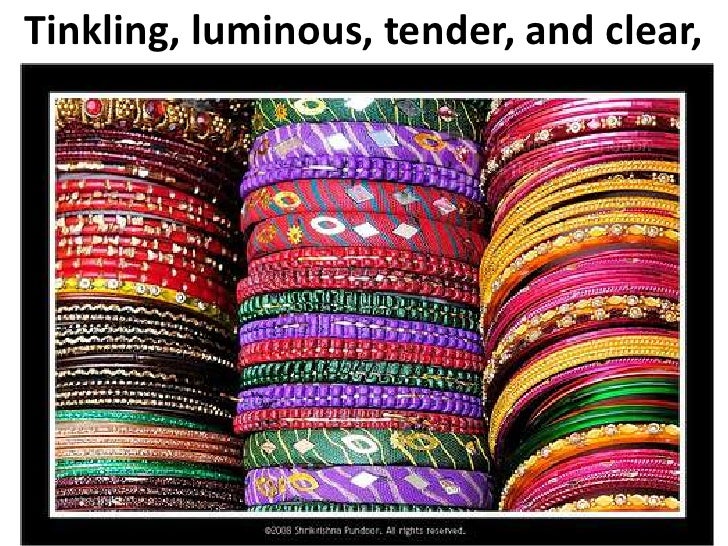
I. (i) The shining bangles that are being carried by the bangle sellers to the temple fair for sale are referred to as shining loads. Women of every age group are the prospective buyers of these bangles
(ii) Temple fair is the place which is visited by women of all age groups. Here the bangle sellers can sell their goods to "happy daughters and happy wives."
(iii) The figure of speech used here is a metaphor as multi hue'


Image result for The Bangle Sellers
II (i) bangles are compared to the radiant lives of "happy daughters and happy wives." The multi-coloured bangles have been linked to the dreams, youthfulness and aspirations of "happy daughters and happy wives." The bangle sellers are the carriers of those "shining loads" that glorify the idea of Indian womanhood. They try to convince buyers of the spiritual and symbolic importance of the bangles in the lives of "happy daughters and happy wives."The bangles are symbolic of different stages of womanhood. The bangle sellers go the temple fair to sell bangles as women of every age would be present there. The poet's descriptive skills are reflected in the way she has expressed the different stages in a traditional Indian woman's life. For example, in a single stanza she has described bangles as "shining loads", "Rainbow-tinted circles of light", and "Lustrous tokens of radiant lives". Silver and blue coloured bangles are befitting a maiden's wrist. These bangles are compared to blue and silver mist of mountains as they symbolise the freshness and the beauty of young maidens.
(ii) The bangles are suitable for the bud-like young maidens who dream of their happy future. They dream of growing up and blossoming like beautiful flowers. The figure of speech personification.
(iii) Some of the bangles have shades of pink of yet to bloom flowers on a woodland stream. The bangles suitable for maiden's wrist are seen in association with the clear dew drops on newborn leaves. The "new born leaves" are symbolic of maidens who are pure, fresh and chaste. They are yet to see to the world.
• Silver and blue: Like the mountain mists or streams maidens are fresh beautiful and evolving.
• Shades of pink: Like buds of flowers maidens dream of a happy future.
• Clear and green: Like dew drops on new born leaves maidens are pure, fresh and chaste. Golden or yellow coloured bangles, suitable for a bride are compared to "fields of sunlight corn". The corn fields — a proof of Mother Nature's fertility are symbolic of the fertility of a young girl getting married.
(ii) Refer to Notes, Page 39. These phrases are compared to the bangles suitable for a bride,
which are luminous, bright and tinkling. The bangles are symbolic of her entry into a new life.
(iii) Simile, in which a likeness between two different things is stated in an explicit way using the words 'like' or 'as'. In these lines the golden and red coloured bangles suitable for a bride are compared to the flame of her marriage fire and the love that she would experience in her new life.
(iv) The colour of the bangles suitable for a woman on her wedding day is compared to the reddish yellow flame of marriage around which the bride takes marriage vows with her groom. The flame-like colour of bangles is appropriate to symbolise the flame of love in marriage.
(v) The bangles worn by a bride in a Traditional Indian Wedding have spiritual and symbolic significance. Refer to Celebration of Indian Womanhood, under Themes, Page 40.

Image result for The Bangle Sellers
(i) For a woman "who has journeyed through life midway" and has gained experience and wisdom. These bangles symbolise that phase when the maiden turned bride becomes a proud mother and responsible wife. She has experienced all the aspects of being a woman.
(ii) Colours represent various moods and aspects of life. In the above extract, all the aspects of being a woman have been experienced. The colours chosen for her bangles are purple and gold flecked grey. Purple colour indicates power, authority, pride and dignity and gold flecked grey, a sober colour, indicates experience and wisdom. Thus, the woman wearing purple bangles has gained maturity, reared her children with love and at last has achieved the fullness of her role as wife and mother.
(iii) The lines are relevant to the concept of Indian motherhood. The bangle sellers attribute purple and gold flecked grey bangles to the mother who. has attained maturity by rearing her children. The bangles are suitable for those hands that have cherished, loved, blessed and cradled her sons.
(iv) "Fruitful pride" is a significant phrase in context of a woman who has "journeyed through life midway"; she has been a loving daughter, a happy bride; a responsible wife and mother. Her experiences have made her a perfect Indian woman. She has been productive and fecund for her family and thus "serves her household in fruitful pride."

(v) Refer to the Themes, Page 40. 

The Cold Within

The Cold Within
James Patrick Kinney
ASSIGNMENTS
Image result for the cold within
(i) Alliteration (close repetition of consonant sound /b/). The adjectives bleak and bitter define the word cold. The coldness outside is comparable to the coldness within the hearts of these six characters as they are not warm or friendly with each other.
(ii) The people referred to are six indifferent people, who are trapped together by chance in biting cold. They need logs so that they can renew the dying fire to prevent themselves from cold.
(iii) The "first one" can be said to be holding a racist attitude as she does not want to benefit the black man. The "next man" can be said to be a bigot who on seeing that one of the men in the group does not belong to his religion, does not use his log to renew the fire.
(iv) The first person holds back her log because she was guided by her racist attitude towards the black man. So she does not use her log to prevent the black man from getting its warmth.
(v) Refer to Lack of warmth in human relations, under Themes, Page 29.

Related image
II. (i) Tattered clothes refer to the torn clothes. This expression symbolises that the man, who was wearing them was poor and had little money to cover himself in extreme cold. The poor man does not intend to use his log to renew the fire and thus to protect himself from biting cold, he pulled up his coat to feel little warm.
(ii) The "third one" is a poor man and is envious of the rich man. He is prejudiced and thus does not put his log to use.
(iii) The thoughts of keeping his wealth safe from the lazy poor man preoccupied the rich man's mind. It reflects his class bias.
(iv) The black man is filled with revenge for the white man. Based on colour of the skin, he considers the white man different from himself.
(v) The lines refer to the black man, who was filled with revenge for the white man. Therefore, to harm the white man he does not put his log to use. Making the white man suffer in cold was his only chance to get his revenge.

Image result for the cold within
III. (i) The phrase "forlorn group" is an example of oxymoron i.e. a pair of contradictory terms. This phrase is ironical as it refers to these six people, who were sitting together in a group and were said and lonely.
(ii) The selfish game of give and take that the last man employs since anyone else does not offer his log to renew the fire, he also steps back.
(iii) All the six people died with their logs tightly clutched in their hands. Their indifference, animosity, discrimination invited death. This "proof of human sin' is referred to here.
(iv) Refer to Title under Critical remarks, Page 3 1 .
(v) The message that the poet tries to give is that discriminatory attitude and hatred that humans have against one other on the basis of race, class and religion is futile. It is self-destructive. Refer to Futility of Discrimination under Themes, Page 29.